Fashion and technical designer Laisim Soeung on heritage, precision, and the discipline of care
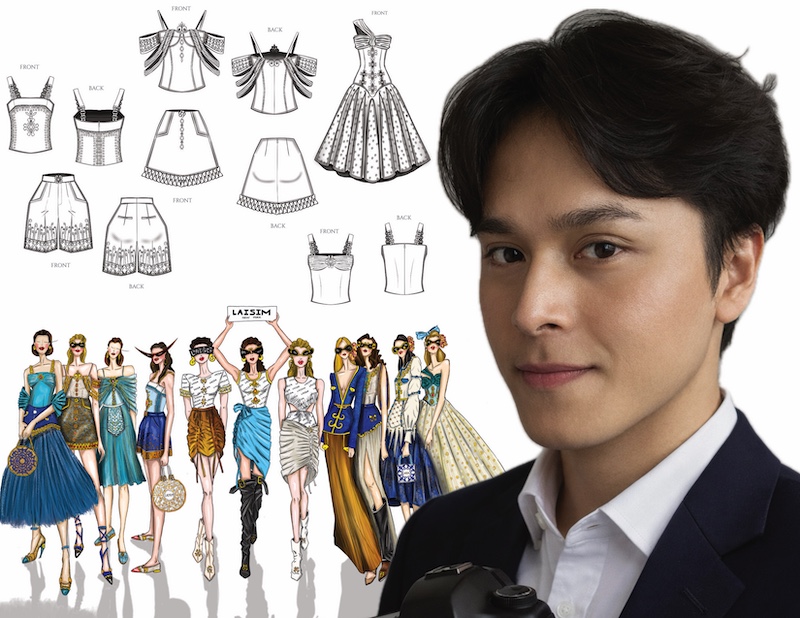
Some designers arrive in New York chasing noise. Laisim Soeung came searching for quiet. Raised and first trained in Phnom Penh, Cambodia, and now based in the East Village at 10003, Soeung belongs to a rare category of maker who treats fashion as a discipline of attention rather than a contest of spectacle. He is at once a fashion designer and a technical designer, a creator equally fluent in the romance of couture and the exacting language of the tech pack, and that duality quietly defines everything he touches.
Soeung has built a practice that moves fluidly across menswear, womenswear, tailoring, couture, and accessories. His portfolio at www.laisim.com reads less like a catalog and more like a soft manifesto: couture gowns rendered with sculptural restraint, ready-to-wear menswear with a sensual undertone, jewelry and footwear conceived as modern heirlooms, and an illustration practice that treats drawing as a form of cultural memory. Recent chapters of his career include a project-based engagement at 3.1 Phillip Lim and formative years in the ateliers and on the runways of Phnom Penh.
What unites the work is a philosophy Soeung returns to again and again: that clothing should offer more than appearance. It should provide what he calls emotional safety, a sense of calm and dignity worn close to the body. From the Kazakh-inspired Koshkar Muiz collection to the playful elegance of his Dice of Heart menswear, his garments carry stories without ever raising their voice.
We spoke with Soeung about culture, construction, the role of technology in craft, and why, for him, fashion will always be a journey rather than a destination.
ELUCID MAGAZINE: Your path runs from Phnom Penh to the studios of New York. How did those two worlds shape the designer you have become?
Laisim Soeung: Cambodia taught me reverence. In Phnom Penh, I grew up surrounded by textile traditions, by people who understood that a garment carries memory and meaning, not only function. My earliest professional years there, working alongside pattern makers and production teams, gave me the grammar of construction: how a seam behaves, how a single measurement decides whether a piece succeeds or fails. New York gave me a different gift: structure and ambition. The city sharpened my eye and pushed me to articulate why I make what I make, not simply how. The two places live in constant conversation within me. From Cambodia, I carry patience and respect for the hand. From New York, I carry rigor and the courage to take an idea further than feels comfortable. I do not see them as separate chapters. I see them as two languages I am fortunate to speak, and the most honest work I do happens where they meet.
ELUCID MAGAZINE: The phrase "emotional safety" appears throughout your work. It is an unusual idea in fashion. What does it mean to you?
Emotional safety is the quiet center of everything I make. We speak often about how clothing looks and rarely about how it makes a person feel when no one is watching. For me, a garment should offer a sense of calm and protection, a kind of dignity worn close to the skin. When someone puts on a piece I have designed, I want their shoulders to soften, not tense. I want them to feel held rather than judged. Achieving that is not sentimental; it is technical. It lives in the weight of a fabric, the place where a seam falls, the way a sleeve releases the arm rather than restricting it. Confidence that has to shout is fragile. The confidence I am drawn to is quiet, settled, and entirely the wearer's own. So when I design, I am not only asking what this garment says to the room. I am asking what it whispers to the person inside it.
ELUCID MAGAZINE: Your Koshkar Muiz collection draws directly on a Kazakh national symbol, translating it into silhouette, color, and ornament. How do you approach borrowing from a culture with care rather than appropriation?
I begin with study and humility. The Koshkar Muiz motif, whose name means ram's horns, is not decoration to me. It is a symbol of strength, prosperity, and the nomadic heritage of the Kazakh people, and it appears on their national flag, adopted in June of 1992. Before I drew a single line, I learned what the motif means and why it matters. I then translated its spirit rather than copying its surface, letting the flowing curves and the symmetry inform silhouette, detailing, and ornament, and drawing the turquoise and gold of the flag into the palette to speak of sky, sun, and freedom. Borrowing with care means asking whether you are honoring a culture or merely consuming it. I try to leave a tradition more visible and more respected than I found it, never reduced to a trend. The collection is my homage, offered with gratitude, and never a costume.
ELUCID MAGAZINE: The Dice of Heart reimagines menswear through the suits of a deck of cards, with a sensuality that feels both playful and refined. What were you exploring there?
The Dice of Heart began as a smile. I was thinking about chance, romance, and the theater of getting dressed, and the suits of a deck of cards gave me a vocabulary: hearts, spades, diamonds, and clubs, motifs that are graphic yet intimate. I wanted menswear that felt casual and elegant at once, with a strong presence but no armor. The wide shirts and the white scarf tied as a soft bow were deliberate. They introduce a sensuality that men's tailoring often denies itself, a looseness that reads as confidence rather than effort. For me, masculinity is most compelling when it can afford to be tender. So the collection plays, but it never jokes at the wearer's expense. It is a romantic and modern vision of how a man might dress when he has nothing to prove and everything to enjoy.
ELUCID MAGAZINE: You describe yourself as both a fashion designer and a technical designer. Many treat those as opposites. Why do you hold them together?
Because I have never believed that precision and poetry are enemies. A tech pack, with its flat sketches, points of measure, and construction notes, is not the opposite of creativity. It is what allows a beautiful idea to survive contact with reality. I have spent years producing those documents, updating flats after fittings, recording corrections, making certain a sample becomes the garment it was meant to be. That discipline does not cage my imagination; it frees it. When I trust the construction completely, I can take greater risks with form, because I know the piece will hold. Many designers hand the technical work to someone else and lose something in the translation. I prefer to hold both, so that the dream and the engineering belong to the same mind. The romance of fashion is real, but romance without rigor rarely makes it to the body. I want mine to arrive intact.
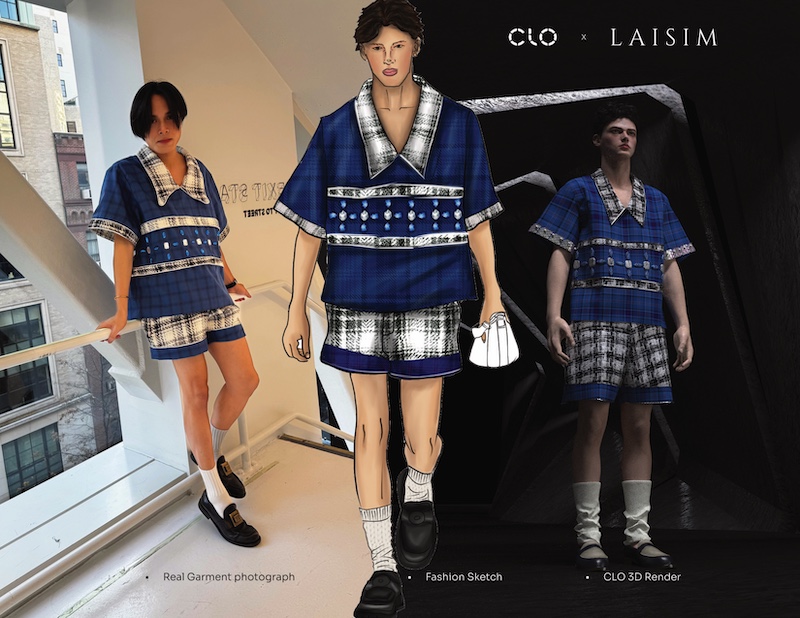
ELUCID MAGAZINE: You have worked with CLO 3D for two years now. How does technology serve your hands rather than replace them?
Technology, for me, is a quiet assistant, never the author. I build garments digitally so that I can study proportion, drape, and movement before a single meter of cloth is cut. It lets me test an instinct, refine a balance, and reduce waste, all before the hand begins its real work. But the screen is only a rehearsal. The decision a fabric makes when it finally falls across the body cannot be fully predicted by software, and I would not want it to be. So I use digital tools to extend my precision and protect the material, then I return to the table, to the needle and the iron, where the truth of a garment is actually decided. Technology refines craftsmanship. It does not replace the intelligence of the hand, and I am careful never to let it try.
ELUCID MAGAZINE: Illustration is clearly central to your process. Series such as Jungle Drapes, The Temple, and Thread of Belonging feel almost like visual essays. What does drawing give you that garment making cannot?
Drawing is where I think most freely. Before a garment exists, illustration lets me explore silhouette, movement, and atmosphere without the weight of construction or cost. It is the fastest path between a feeling and a form. Series such as Jungle Drapes, the Temple, and Thread of Belonging are something more, though. They are visual essays, ways of honoring cultural memory, heritage, and the quiet resilience of communities whose stories deserve to be seen. There, I am not solving a production problem; I am asking a question and answering it in line and color. Drawing gives me permission to be poetic before I must be practical. It holds the emotion of an idea in its purest state, and I often return to those images later, when a collection needs to remember what it was originally reaching for. Illustration keeps the soul of the work visible, even as the work becomes precise.
ELUCID MAGAZINE: Your couture pieces, the Bopha Dress and the Étoile Dress among them, carry a level of handwork that is increasingly rare. Can you take us inside that making?
With great patience and a refusal to rush. The Bopha Dress is crafted from lustrous silk satin and features silk ribbon latticework woven entirely by hand, creating a raised, almost sculptural texture across the body. Then come the fabric rosettes, the bead accents, and the hand-finished tassels, each adding depth and softness. The Étoile Dress works differently, with a delicately structured bodice featuring fine beadwork and a skirt layered with airy tulle beneath a smooth outer fabric, so it moves like breath. None of this can be hurried. Couture of this kind is a record of hours, of decisions made stitch by stitch. When people ask why such pieces carry the value they do, the answer is time, skill, and the human hand. To wear one is to wear someone's complete attention. In a culture addicted to speed, I find something almost defiant in making slowly and making well.
ELUCID MAGAZINE: Your accessories, the Sun of Muiz ring and the Golden Stride heels, are described as modern heirlooms. What does it mean to design an object meant to be inherited?
To design an heirloom is to design for a future you will not witness. The Sun of Muiz ring places a brilliant white diamond, the sun of the Kazakh flag, at the heart of a band whose spiral curves echo the ram's horn motif, with smaller stones tracing a sense of continuity. The Golden Stride heels carry the same curled forms in golden detail, with an ankle strap engraved with the Laisim name. I think of both as objects that should outlive their first season and pass from one hand to another, gathering meaning as they go. That ambition changes how you make. You choose materials that endure, forms that will not embarrass the wearer a decade from now, and stories worth keeping. An accessory is small, but it can carry an entire heritage. I would rather create a few things meant to be treasured than many things meant to be replaced.
ELUCID MAGAZINE: You often call your work an ongoing journey rather than a destination. Where is that journey taking you next?
Forward, and inward at the same time. My Spring Summer 2026 work is taking shape now, and with it a clearer sense of the house I hope to build, one where culture, craftsmanship, and contemporary design are never in competition. I want to keep deepening my research, to keep learning techniques both ancient and new, and to let the work mature without forcing it. I have never been interested in arriving. The designers I admire treat their practice as a lifelong study, and I feel the same. Each collection teaches me what the next one must address. So the honest answer is that I am still becoming the designer I want to be, and I hope I always feel that way. The day I believe I have finished learning is the day the work loses its quiet. I would like to keep listening, keep refining, and keep making clothes that, above all, let people feel at home in themselves.
Laisim Soeung is a fashion and technical designer based in New York City. His work can be viewed at www.laisim.com.